Imagine If Planets Were As Close As The Moon
http://media.talkingpointsmemo.com/slideshow/if-planets-were-as-close-to-earth-as-moon
Neat idea.
Currently I'm rebuilding my studio set up so I can get more even lighting. This includes building a table strong enough to hold my tank, and setting up a white box out of foam board (or science fair display boards) to help bounce light to get a more even illumination. In the spare time I've been reading Drifting on Alien Winds which just came in a few days ago and managed to catch an interesting documentary on the weather channel about other planet's weather.
This week I'm submitting Jupiter and Mars series to IEEE VIS 2013 (July 15 http://visap2013.sista.arizona.edu/) and Science Inspires Art: The Cosmos (July 21 http://www.asci.org/artikel1187.html)
Tuesday, July 9, 2013

Monday, July 1, 2013
Neptune Update
I was able to get in contact with an artist and scientist at JPL, and I was able to get some feedback as well as some great resources. One resources was the book Drifting on Alien winds, fortunately the Neptune chapter was available online so I could use it in my research right now, but I did order the book. This book has been the best resources I've come across, the author is an artist that specializes in space illustrations, so his book is very descriptive on the atmospheres across different planets and moons.
 I've put off shooting for two reasons, one I was waiting on a timer to come in for a better dslr (the t3i's had too much noise to my liking, so I was waiting on the 5d timer to come in) and second was to get feedback/advice from a scientist that studied the planet. I haven't had much luck getting in contact with a scientist, I imagine summer is difficult to get a hold of people. But I did design an experiment, and I will be doing Neptunes first test shoot Monday, July 1st. Right now I'm looking two methods. First is a tank full of water with a layer of oil at the top, and dropping condensed milk through that way there's more of a cloud effect. Second method is to suspend cotton using fishing line off of mesh in a water tank to get a cloud effect. That will give me more control.
In addition I've been submitting to contest, galleries, proposals etc. I did hear back from one that I did get selected for, which is Peripheral ARTeries magazine which is an art review of new artists.

In addition I've been submitting to contest, galleries, proposals etc. I did hear back from one that I did get selected for, which is Peripheral ARTeries magazine which is an art review of new artists.
Monday, June 17, 2013
Initial Neptune Research
After conducting initial research, the main question I have is what would the color of the surface (or rather inside) of Neptune would look like. I'm unsure whether the blue would carry on through to the interior of the planet, since the methane gas clouds is responsible for the blue, supposedly there's ice and an unknown substance as well that could change the color.
Neptune
Neptune is a gas giant planet, so it
doesn’t have a solid surface. The blue-green ball that we see in photographs of
Neptune is really the top of the clouds on Neptune. If you could dive down
beneath the surface of Neptune, you would find an interior with increasing
temperatures and pressures right down to the rocky core at the center.
So, we’re clear that the surface of
Neptune isn’t solid. There’s no standing on Neptune. That said, the “surface of
Neptune” that we see is one the most active and dynamic places in the Solar
System. For some reason, that astronomers haven’t figured out, the interior of
Neptune is unusually hot. Even though Neptune is much further from the Sun than
Uranus and receives 40% less sunlight, its surface temperature is about the
same. In fact, Neptune gives off 2.6 times more energy than it takes in from
the Sun. Even without the Sun, Neptune glows.
This high amount of interior heat
matched with the coldness of space creates a huge temperature difference. And
this sets the winds blasting around Neptune. Maximum wind speeds on Jupiter can
be more than 500 km/hour. That’s twice the speed of the strongest hurricanes on
Earth. But that’s nothing compared to Neptune. Astronomers have calculated
winds blasting across the surface of Neptune at 2,100 km/hour.
When NASA’s Voyager 2 spacecraft
visited Neptune in 1989, it also discovered the planet’s Great Dark Spot, a
huge storm like Jupiter’s Great Red Spot. But unlike Jupiter, the Dark Spot
didn’t seem to be very stable, and had already disappeared by 1994 when the
Hubble Space Telescope tried to locate it.
Deep down inside Neptune, the planet
might have a solid surface. At the very core of Neptune is thought to be a
region of rock with roughly the mass of the Earth. But temperatures at this
region would be thousands of degrees; hot enough to melt rock. And the pressure
from the weight of all the atmosphere would be crushing. There would be no way
to walk around on the “surface of Neptune”.
The interior is presumed to contain
a rocky core with an icy mantle topped by a deep layer of liquid hydrogen.
Voyager 2's instruments detected a complex magnetic field. Like Uranus, the
field is tipped with respect to the axis of rotation and offset from the center
(the tilt is 50 degrees for Neptune, compared with 60 degrees for Uranus).
However, the field is somewhat weaker than for Uranus. As for Uranus, it is speculated that this magnetic field my originate in a conducting shell not far below the clouds, rather than deep in the interior as for Jupiter or the Earth. In that case, the conducting material would not be metallic hydrogen, as for Jupiter, or iron and nickel, as for the Earth. As noted earlier for Uranus, a mixture of water, methane, and ammonia under the right pressure could be responsible.
http://csep10.phys.utk.edu/astr161/lect/neptune/surface.html
Neptune's blue appearance comes from the layer of methane
gas that sits above the clouds. Methane absorbs red light, so only the bluish
colors show up when viewing the planet.
Much is still unknown about Neptune, because the strong pressure makes it impossible for us to land on the planet. It is thought that there is an ocean of really hot water on Neptune's surface. The planet's pressure makes it impossible for the water to boil away.
The only spacecraft to visit Neptune was the Voyager 2 in 1989. Voyager confirmed that Neptune's atmosphere was very cold and very windy. In fact, the surface of Neptune reaches 200 degrees below zero! Regardless of the frigid temperatures, Neptune's core remains very warm. Neptune actually gives off more heat than it receives from the Sun.
Much is still unknown about Neptune, because the strong pressure makes it impossible for us to land on the planet. It is thought that there is an ocean of really hot water on Neptune's surface. The planet's pressure makes it impossible for the water to boil away.
The only spacecraft to visit Neptune was the Voyager 2 in 1989. Voyager confirmed that Neptune's atmosphere was very cold and very windy. In fact, the surface of Neptune reaches 200 degrees below zero! Regardless of the frigid temperatures, Neptune's core remains very warm. Neptune actually gives off more heat than it receives from the Sun.
Yahoo Answers
Chemistry
- According to the Smithsonian Museum, hydrogen, helium
and methane dominate Neptune's ambiguous surface. At near-surface
conditions, these chemicals exist as gases. Frozen methane forms clouds
that are visible from space, just like frozen water does on Earth. The
Great Dark Spot storm system
 is a distinguishing surface feature on Neptune. The storm was a
hurricane-like feature similar to Jupiter's Great Red Spot. The storm's
dark feature offers a glimpse into the deeper layers of Neptune's
atmosphere. As one travels down into the giant planet, pressure and
internal heat transform the hydrogen and methane gases into a compressed
fluid.
is a distinguishing surface feature on Neptune. The storm was a
hurricane-like feature similar to Jupiter's Great Red Spot. The storm's
dark feature offers a glimpse into the deeper layers of Neptune's
atmosphere. As one travels down into the giant planet, pressure and
internal heat transform the hydrogen and methane gases into a compressed
fluid.
Planets get their color from what they are made of -- their
composition. Both Uranus and Neptune get their blue-green color from methane,
but Neptune is a more vivid and brighter blue, which points to Neptune having
an unknown component.
Neptune does not have a solid surface, but its atmosphere
(made up mostly of hydrogen, helium and methane) extends to great depths,
gradually merging into water and other melted ices over a heavier,
approximately Earth-size solid core.
Neptune's atmosphere extends to great depths, gradually
merging into water and other melted ices over a heavier, approximately
Earth-size solid core. Neptune's blue color is the result of methane in the
atmosphere. Uranus' blue-green color is also the result of atmospheric methane,
but Neptune is a more vivid, brighter blue, so there must be an unknown
component that causes the more intense color.
Thursday, June 6, 2013

Wednesday, June 5, 2013


Monday, April 15, 2013
Jupiter Tank Stuff

Got a little bit of banding in the video. Turns out the florescent cold lights are the culprit behind it. I'm currently in research to try to find a different lighting solution or a way around it.
Here's Some Studio Shots:
 |
| Studio Set Up |
 |
| After the shoot |
 |
| what cotton looks like behind tank of water and a plexiglass divider |
 |
| Used the end of a paint brush next to the plexi glass divider to get focus |
I tried using christmas lights but the lights were not bright enough against the cold light I were using to light up the tank. Also it was a bit of a safety hazard, since a safety cut off outlet wasn't nearby. So, My next idea is to get several mini led flash lights or something similar, and set them up behind the cotton like the Xmas lights.
Photo Editing Style Tests:


Tuesday, April 2, 2013
Jupiter Research & Experiment Round 1
After doing initial research on Jupiter and traditional visual fx on film, I was still unsure what Jupiter looked like since it was made mostly of metallic hydrogen, which has rarely ever been seen on earth by a few accidents. So I contacted a professor in chemistry, Beverly Clement, who gave me a fantastic poetic visual description of metallic hydrogen. I've posted her description below:
 Think
of hydrogen as the ultimate gas that is only forced into liquid state
under extreme conditions and anything (from gently falling cosmic dust
to impact form space debris) will cause the liquid to vaporize – with
the simultaneous release of light energy and formation of solid
hydrogen."
Think
of hydrogen as the ultimate gas that is only forced into liquid state
under extreme conditions and anything (from gently falling cosmic dust
to impact form space debris) will cause the liquid to vaporize – with
the simultaneous release of light energy and formation of solid
hydrogen."
My Jupiter visualizations will be based off these descriptions.
Currently, my dividers for my water tank are drying with silicon on them. The silicon takes 24 hours to dry so they'll be ready to test tomorrow.
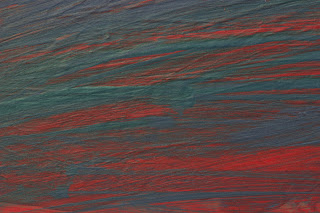
Meanwhile, I had 2 other side projects going along, one with cotton and the other with paint. Here are the results with a Macro lens and different lighting set ups with the paint. The paint it suppose to demonstrate the colors of metallic hydrogen where it's a blue with blushing shades of red, but not pigmented and the colors are separated. I'm not entirely happy with the results, I'm thinking of sanding down the paint so it has more smooth look, or try some digital manipulating to smooth it out. I'm also going to use this paints in the water tank to see if the looks is better.




I'll be getting Christmas lights to put behind the cotton to demonstrate the light geysers of excited hydrogen. Once I have the tank tests going, I'll be experimenting using the cotton as a backdrop to the tank and as compositing. But up close I feel the cotton is successful to give a gaseous look so I'm happy with the results.


Also, this past week I launched my website! www.cassandrahanks.com
"This
is the emission spectrum of hydrogen. Without the aid of a prism or
grating the color you see from ‘excited’ hydrogen is a blue with pink
overtones – not a pigment effect but two clean simultaneously visible
colors, one blue the other red so you get the impression of a blue that
is almost blushing. The indigo and violet lines darken the blue cast as
an impression of these colors not a blending with the blue.
The
pure liquid is supposed to be colorless, and as far as thickness or
viscosity, it is a very light liquid without the ability to stick to
other things. It probably wouldn’t pick up many impurities. The only
way that hydrogen can exist as a liquid is either under extreme pressure
or incredibly cold temperatures (roughly 20 degrees above absolute
zero). The slightest disturbance would provide sufficient energy for
spectacular (explosive) vaporizations. These vaporizations would
possibly be visible as geysers of light energy coming from a seething
surface. Since there isn’t really any energy involved in holding the
liquid hydrogen together, wave action would probably be sufficient to
excite the hydrogen at the crests of any waves to possibly emit light of
these emissions at the points of the waves and any sprays that might
stream from these crests. This evaporation would probably also produce
some solid hydrogen that would fall and implode on the surface of the
liquid. If solid hydrogen were to exist, it would probably glow
(possibly a blue white). While the term ‘metallic’ hydrogen brings to
mind the metallic luster we associate with metals, hydrogen’s glow would
only be of the excited hydrogen at the surface where the liquid and gas
met or where the action of wind (possibly also made of pure hydrogen)
exciting the surface of the ocean and painting its reverse Aurora
Borealis on the surface.
My Jupiter visualizations will be based off these descriptions.
Currently, my dividers for my water tank are drying with silicon on them. The silicon takes 24 hours to dry so they'll be ready to test tomorrow.
Meanwhile, I had 2 other side projects going along, one with cotton and the other with paint. Here are the results with a Macro lens and different lighting set ups with the paint. The paint it suppose to demonstrate the colors of metallic hydrogen where it's a blue with blushing shades of red, but not pigmented and the colors are separated. I'm not entirely happy with the results, I'm thinking of sanding down the paint so it has more smooth look, or try some digital manipulating to smooth it out. I'm also going to use this paints in the water tank to see if the looks is better.


I'll be getting Christmas lights to put behind the cotton to demonstrate the light geysers of excited hydrogen. Once I have the tank tests going, I'll be experimenting using the cotton as a backdrop to the tank and as compositing. But up close I feel the cotton is successful to give a gaseous look so I'm happy with the results.


Also, this past week I launched my website! www.cassandrahanks.com
Subscribe to:
Posts (Atom)